
Alternative credit scoring in LATAM
Expand lending, reach underserved borrowers, and maintain portfolio quality using behavioural analytics and alternative data.
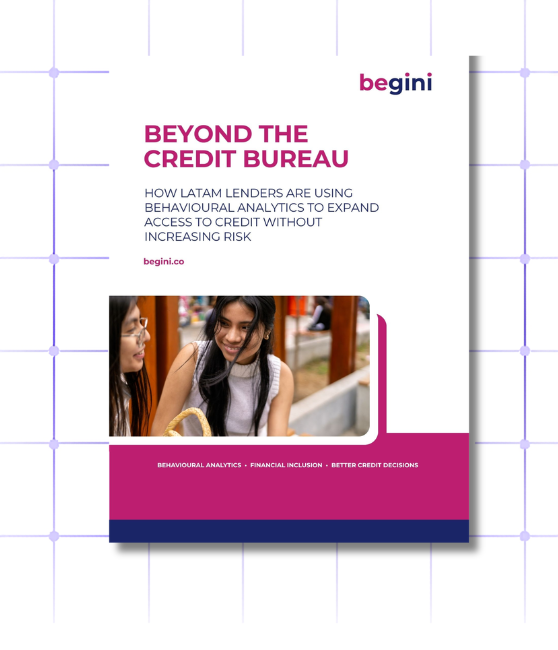
What You’ll Learn
In this white paper, you’ll discover:

Why traditional credit models limit growth in LATAM
How alternative credit scoring in LATAM helps assess thin-file and first-time borrowers
The role of behavioural analytics in improving risk differentiation
Real-world examples from lenders in Colombia and Honduras
How to expand lending without increasing portfolio risk
Built for LATAM lending environment
How does alternative credit scoring in LATAM work in practice?
It integrates seamlessly into existing digital onboarding and credit assessment processes. Behavioural insights are captured during the application journey, providing additional data points without adding friction for the applicant.
Is it suitable for low-data or informal economies?
Yes. Alternative credit scoring in LATAM is specifically designed for markets where many borrowers have limited or no formal credit history. It enables lenders to assess applicants based on behaviour, rather than relying solely on historical financial data.
Does it require sensitive personal data?
No. Behavioural analytics focuses on how applicants interact with the process, not on collecting additional personal or sensitive information. This supports privacy-conscious lending while still improving risk assessment.
Will it impact the customer experience?
Positively. The approach is mobile-first, intuitive, and designed for high completion rates—even among users with low digital literacy. In many cases, it enhances engagement rather than creating friction.
How quickly can it be implemented?
Solutions are designed to be lightweight and fast to deploy, allowing lenders to integrate alternative credit scoring in LATAM into their workflows without major system changes.
Is this only for fintech lenders?
No. Both fintechs and traditional financial institutions are using alternative credit scoring in LATAM to expand lending, improve risk visibility, and reach underserved segments.